
There are summers that are remembered for record visitor numbers, landmark events or exceptional weather. And then there are summers that reveal something more important about an industry. The summer of 2026 is becoming one of those.
Across Europe, the visitor economy is once again being tested. Exceptionally low water levels have required river cruise companies to amend itineraries on parts of the Rhine and Danube. Wildfires and extreme heat have brought evacuations and disruption across France, Spain, Portugal and Greece. In Mallorca, protests against mass tourism have coincided with industrial action at Palma Airport, while Barcelona continues to confront difficult questions about visitor numbers, housing, mobility and the long-term character of the city.
Viewed individually, these are separate stories. Viewed together, they tell us something much more significant. They reveal an industry that is being asked to demonstrate not simply its capacity for growth, but its capacity for resilience.
Tourism has always been exposed to events beyond its control. Weather changes, borders close, aircraft are grounded, rivers rise and fall, industrial disputes interrupt carefully constructed plans, and public attitudes towards visitors evolve. None of this is entirely new. What feels different today is the frequency with which pressures overlap and the speed with which their effects travel through an increasingly interconnected visitor economy.
A period of extreme heat can affect aviation, railways, roads, attractions, hotels, cruise operations and the health of guests and employees at the same time. Low water on a major river may begin as a navigational problem, but it quickly becomes a transport, accommodation, guiding, communications and customer-service challenge. A protest directed primarily at housing policy or destination management can nevertheless affect the atmosphere experienced by visitors, the confidence of staff and the reputation of businesses that have little direct influence over the underlying issue.
This is what makes the summer of 2026 feel less like a collection of isolated disruptions and more like a stress test, and why tourism operational resilience has become such an important leadership issue. The question is no longer whether tourism businesses have a contingency plan for one identifiable incident. It is whether their people, systems, partnerships and leadership cultures are sufficiently adaptable to manage several forms of uncertainty at once without losing the confidence of their customers or placing intolerable pressure on their teams.
Over almost fifty years in travel, I have seen the industry respond to the Achille Lauro hijacking, Chernobyl, the Gulf Wars, 9/11, financial crises, volcanic ash, terrorism, political instability, pandemics and conflicts that changed air routes and unsettled traveller confidence. Each event arrived with its own causes, geography and consequences. At the time, many felt unprecedented, and in their particular circumstances they were.
Yet the longer one works through disruption, the more clearly certain patterns emerge. Leaders rarely possess all the information they would like at the moment decisions must be made. Early reports are often incomplete or contradictory. Media coverage can magnify anxiety faster than organisations can establish the facts. Customers want certainty when certainty may not yet exist, while employees and suppliers look to the business for direction even as the leadership team is still trying to understand the scale of the problem.
The temptation in such moments is either to move too quickly, responding to every development as though it will become permanent, or to move too slowly in the hope that normality will return before difficult decisions become necessary. Experienced leadership lies somewhere between those extremes. It requires the ability to establish what is known, distinguish immediate operational facts from speculation, communicate honestly without creating unnecessary alarm, and act decisively where the consequences of delay would be greater than the consequences of adjustment.
The details of each crisis may change, but the disciplines of good leadership remain remarkably consistent: clarity, communication, flexibility, financial awareness, care for people and the confidence to make decisions before every uncertainty has been resolved.
For many years, tourism operational resilience was largely understood as the ability to keep a programme moving. If a hotel became unavailable, another was found. If an attraction closed, the itinerary changed. If a flight was cancelled, alternative transport was arranged. Those capabilities remain essential, but the operating environment now requires us to think about resilience across three connected dimensions: environmental, operational and social.
Environmental resilience begins with recognising that climate conditions can no longer be treated merely as occasional exceptions to otherwise predictable seasons. Low river levels, extreme heat, wildfires, flooding and water scarcity are becoming material operating considerations for destinations and businesses. This does not mean assuming that every season will be defined by catastrophe, nor does it justify alarmist predictions. It does mean planning with a wider range of conditions in mind and considering how products, transport arrangements, staffing, guest information and supplier agreements may need to adapt.
For a river cruise operator, resilience may involve ship swaps, alternative docking points, revised excursions or carefully coordinated transfers by road. For a tour operator, it may mean reviewing the timing of visits, the physical demands placed upon guests during periods of intense heat, and the availability of alternative routes or experiences. For attractions and destinations, it may involve shaded areas, water provision, crowd management, emergency communications and greater coordination with local services. The operational response will vary, but the underlying principle is the same: environmental conditions are becoming part of product planning rather than something considered only after disruption occurs.
Operational resilience concerns the organisation’s ability to convert awareness into action. It depends upon timely information, clearly defined authority, trained and confident frontline employees, flexible supplier arrangements and the ability to communicate consistently across different markets and languages. It also requires financial judgement, because protecting the guest experience during disruption frequently carries a cost before its longer-term value becomes apparent.
The strongest operational response is not always the one that preserves every line of the original itinerary. Sometimes the more resilient decision is to abandon an increasingly fragile plan and replace it with something that can be delivered well. Guests will generally understand that a river cannot be made deeper, a wildfire cannot be negotiated with and an airport dispute cannot be resolved by their tour director. What they are less likely to forgive is confusion, silence, contradictory messages or an alternative that appears to have been assembled without sufficient thought.
Social resilience is perhaps the least developed part of the conversation, but it may prove to be the most important. Tourism depends upon the continuing consent and participation of the communities in which it operates. When residents feel that housing, public transport, local services or familiar neighbourhoods are being overwhelmed, the resulting frustration cannot simply be dismissed as hostility towards visitors. The protests seen in Barcelona, Mallorca and other European destinations have been shaped by wider concerns about housing affordability, overcrowding and the distribution of tourism’s economic benefits.
An operationally successful tourism season can still be socially unsustainable if the people who live in a destination no longer believe that the industry works in their interests. Social resilience therefore requires a more mature partnership between tourism businesses, local authorities, destination organisations and communities. It asks not only how many visitors a place can accommodate, but how visitor flows are managed, where economic value is retained, how local infrastructure is supported and whether residents can see a credible connection between tourism activity and their own quality of life.
Much of modern tourism has been built around greater efficiency. Aircraft, hotel rooms, coaches and ships are expensive assets, and businesses naturally seek to maximise their use. Technology has improved forecasting, inventory management, staffing and distribution. Supplier commitments have become more precise, operating margins more closely managed and spare capacity increasingly difficult to justify.
All of that makes commercial sense in stable conditions, but an organisation designed entirely around efficiency can become brittle under pressure. The answer is not for tourism businesses to abandon efficiency; rather, it is to consider how much flexibility they must deliberately retain if they are to remain dependable when normal operating conditions no longer apply.
There is always a cost attached to resilience. It may appear in the form of more reliable alternative suppliers, additional operating options, more flexible contractual terms, stronger cash reserves, investment in staff training or the maintenance of capabilities that are not required every day. In a spreadsheet viewed during an uneventful season, some of these measures can look like inefficiencies. Their value becomes visible only when disruption removes the cheaper or more obvious option.
This creates a difficult but important leadership question. How much apparent efficiency is the organisation prepared to surrender in return for greater adaptability? There is no universal answer, because a multinational airline, a family-owned hotel, a destination management company and an escorted tour operator face very different economics. What they share is the need to understand where their most dangerous points of dependency lie and what would happen if one of them failed at the busiest moment of the year.
Resilience is not created by maintaining wasteful duplication everywhere. It is created by knowing where the organisation has no room to manoeuvre and deciding whether that exposure is acceptable.
Tourism products are rarely delivered by one organisation alone. Even a relatively simple journey may depend upon airlines, airports, hotels, transport companies, attractions, restaurants, guides, technology providers and local authorities. The more complex the product, the more its quality depends upon the ability of those different organisations to work together when the original plan begins to unravel.
This is why supplier relationships should be understood as part of a company’s resilience infrastructure. During stable periods, it is easy to reduce relationships to rates, allocations, service-level agreements and contractual obligations. During disruption, their real value lies in the willingness of people to answer the telephone, share information, manage late changes to logistics, hold capacity, consider an unusual request and help create a solution that may not fit neatly within the original agreement.
That goodwill cannot be manufactured at the moment of crisis. It is accumulated through years of fair dealing, reliable payment, open communication and mutual respect. Businesses that treat suppliers solely as costs to be driven down may discover that they have also reduced the depth of support available when circumstances become difficult. Commercial discipline is essential, but the lowest short-term price is not always the lowest long-term risk.
The same principle applies internally. Resilient organisations tend to have strong relationships between their commercial, operational, customer-service and communications teams. They do not wait for a crisis to discover that departments are working with different assumptions or that frontline employees lack access to the information being discussed by senior management. The quality of those connections can determine whether a response feels coordinated and confident or fragmented and reactive.
Travellers do not expect tourism businesses to control the weather, prevent every strike or remove every source of geopolitical uncertainty. They do, however, make judgements about how an organisation behaves when something goes wrong. Increasingly, the response to disruption is becoming part of the visitor experience itself.
What travellers expect is competence: to be informed quickly and honestly, to receive alternatives that feel thoughtful rather than improvised, and to encounter frontline teams who appear confident, informed and empowered to act. They also expect the organisation to recognise the emotional dimension of disruption. A changed itinerary may represent an operational adjustment to the company, but to the guest it may affect a long-awaited anniversary, a family celebration or an experience they have saved towards for years.
This is where strong operators distinguish themselves. They understand that the objective is not simply to complete the contractual elements of the trip, but to preserve trust. A well-managed change can sometimes strengthen a customer’s relationship with a company because it reveals qualities that are less visible when everything proceeds exactly as planned. Care, honesty, resourcefulness and personal attention become tangible.
The opposite is equally true. Poor communication can turn an unavoidable problem into a reputational failure. Silence encourages speculation, inconsistency creates distrust and rigid adherence to an unworkable plan can suggest that protecting internal processes matters more than protecting the guest. In an age when customer experiences are shared publicly and immediately, operational resilience and brand reputation can no longer be considered separately.
Technology has an increasingly important role to play in this environment. Real-time information, operational dashboards, automated alerts, location data, multilingual communication and artificial intelligence can help organisations identify developing problems, communicate at speed and offer more personalised support. Digital tools can also give frontline teams access to information that would once have remained within a control centre or head office.
Used well, these capabilities can materially improve an organisation’s response. They can help reroute guests, update itineraries, translate urgent messages, monitor transport conditions and maintain contact with customers who are dispersed across several locations. They may also make it easier to identify patterns before they become crises, allowing organisations to act earlier rather than waiting for disruption to become visible to everyone.
Technology, however, does not decide what an organisation stands for when circumstances become difficult. It cannot determine how much inconvenience is acceptable, when a programme should be changed, what level of financial support is appropriate or how candidly uncertainty should be explained. Those remain leadership decisions.
A sophisticated communications platform will distribute a poor message more efficiently. An artificial-intelligence system may present several alternatives, but someone must still judge which one best protects safety, customer confidence, employee wellbeing and the long-term reputation of the business. Technology enables resilience; leadership creates it.
The organisations that respond most effectively to disruption are rarely inventing their approach from nothing. They have already considered where their vulnerabilities lie, who has the authority to make decisions, how information will be verified, which audiences need to be contacted and what principles will guide the response.
This preparation does not require a detailed plan for every imaginable event. No organisation can anticipate every combination of weather, politics, transport failure and public reaction. It does require a practical framework that helps people think clearly under pressure. Leaders should know how quickly the business can establish reliable facts, whether frontline teams can act without waiting for several layers of approval, which suppliers or routes provide genuine alternatives, and how long the organisation can absorb additional costs while protecting its customers.
Scenario planning is most useful when it exposes assumptions rather than attempting to predict the future with false precision. What happens if two problems occur simultaneously? Which part of the operation would become overloaded first? Are customer communications dependent upon one person, system or language? Could the business continue if a significant supplier, transport route or destination suddenly became unavailable? These questions are uncomfortable precisely because they reveal where apparent efficiency may be concealing fragility.
Resilience is built before the crisis. It is built in the strength of the balance sheet, the confidence of employees, the quality of supplier relationships, the clarity of decision-making and the trust a brand has earned with its customers. When disruption arrives, an organisation is drawing upon reserves accumulated long beforehand.
The summer of 2026 will pass, as every difficult season eventually does. Rivers will rise, fires will be extinguished, industrial disputes will be settled and the immediate intensity of public debate may recede. The more important question is what the visitor economy chooses to learn from the experience.
It would be easy to treat each event as a temporary operational problem and return to business as usual once the immediate pressure has lifted. That would miss the wider message. Environmental volatility, infrastructure pressure, resident concern and geopolitical uncertainty are not separate conversations. Together, they are changing the conditions in which tourism businesses and destinations must operate.
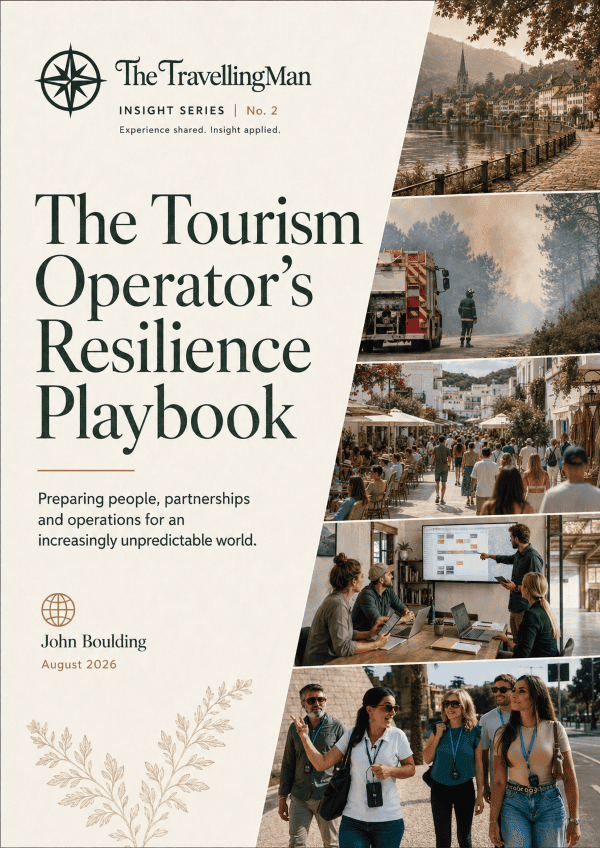
My downloadable companion piece to this article, The Tourism Operator’s Resilience Playbook, sets out a practical framework for leadership teams that want to examine their own readiness. It considers operational dependencies, decision-making authority, supplier relationships, customer communications, technology, scenario planning and the balance between efficiency and adaptability.
A practical framework for preparing your people, partnerships and operations for disruption.
The purpose of the playbook is not to predict the next crisis. Experience has taught me that the next disruption rarely arrives in exactly the form we expect. Its purpose is to help organisations develop the judgement, flexibility and confidence to respond well when certainty disappears.
This publication explores how tourism operators can strengthen resilience through five interconnected pillars. It is not intended as a crisis manual or an exhaustive operational guide. It offers a practical framework to help leadership teams reflect on their own organisations, challenge assumptions and build greater confidence for whatever comes next.
This summer has become a stress test for Europe’s visitor economy. The strongest organisations will not necessarily be those that avoid every disruption. They will be those that continue to earn trust while navigating it.