Last week, Paul Richer invited me to open TTI’s Autumn Conference with a keynote on The Metaverse of Travel. In preparing for it, I found myself returning to a deceptively simple question: whatever happened to the metaverse?
It was not meant dismissively. Only a few years ago, the metaverse was being presented as the future of almost everything: how we would work, shop, meet, entertain ourselves and, inevitably, how we might travel. Yet the word itself seems to have faded almost as quickly as it entered mainstream business thinking.
What became increasingly clear to me, though, was that travel had not rejected the technology. Quite the opposite. Many of the capabilities that once sat beneath the metaverse umbrella have continued to develop at considerable pace: VR and AR, spatial computing, digital twins, wearables, AI, real-time translation, immersive audio, computer vision and increasingly intelligent mobility.
What changed was not so much the technology as what travellers and travel businesses wanted it to do. And that is where the more interesting story begins.
The timing of the original metaverse enthusiasm matters. Covid did not invent virtual tourism, but it gave it unusual relevance. For a period, physical travel simply stopped. Airports emptied, museums and attractions closed, guides lost their groups and destinations lost their visitors.
The industry responded creatively. Museums opened virtual doors. Guides livestreamed walks through cities. Destinations experimented with 360-degree content. VR previews and remote cultural experiences offered people a connection with places they could no longer physically reach.
These experiences had genuine value, but largely because they were solving an extraordinary problem. Virtual travel was not necessarily better than travel. It was better than no travel.
As remote working, online events and digital access became normalised, it was understandable that some began to extrapolate from that exceptional period. Facebook became Meta in 2021, investment accelerated and the idea of persistent virtual worlds moved rapidly from technology circles into mainstream business thinking.
For travel, the proposition was seductive. Perhaps digital experience was not simply what we did while we could not travel. Perhaps it could become an increasingly important substitute for travelling at all.
And then the world reopened.
People travelled again, and they did so with remarkable enthusiasm. By 2024, international tourism had virtually returned to pre-pandemic levels. We even developed a term for some of the pent-up demand: “revenge travel”.
That rebound told us something important. If virtual experiences were going to become a meaningful substitute for travel at scale, we might reasonably have expected to see some evidence of that once physical travel became possible again. Instead, consumers demonstrated just how strongly they still valued being somewhere.
I spent many decades in escorted touring, and one thing that experience teaches you is that travel is never simply a sequence of sights. An itinerary can look perfect on paper and still fail on the road because the experience depends on timing, atmosphere, scale, weather, food, local knowledge, human interaction and a degree of serendipity.
Often, the moments people remember most are not the famous landmarks at all, but a meal, a conversation, an unexpected view or a guide who knows when to tell the story and when to let the place speak for itself.
Digital can show. Travel allows people to be there.
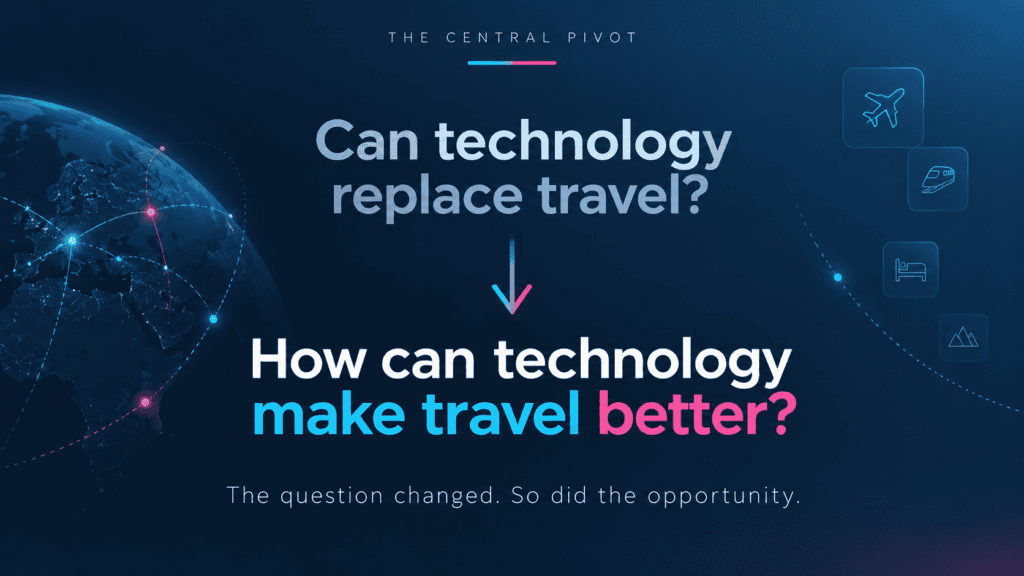
That is why I think the original travel proposition around the metaverse began to lose some of its force. The technologies were not necessarily wrong. We were asking them the wrong question.
Instead of asking whether technology could replace travel, the more useful question became: how can technology make travel better?
Once we make that shift, the picture looks very different. VR can inspire and preview. AI can personalise. Real-time translation can remove language barriers. Smart glasses and spatial audio can provide information without continually pulling the visitor back towards a phone screen. Digital twins can help destinations understand movement, capacity and congestion. Intelligent mobility can make journeys more responsive and increasingly personalised.
Rather than disappearing into a virtual destination, the traveller remains in the real one.
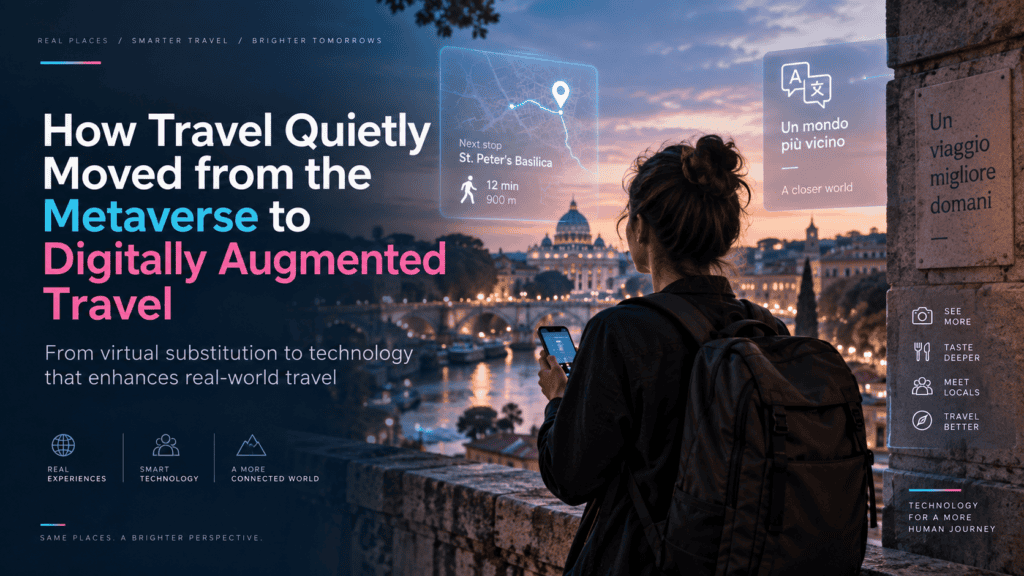
I find it useful to think of this emerging phase as digitally augmented travel. I do not mean augmented reality in the narrow technical sense, but something broader.
Digitally augmented travel is the use of technology to add useful layers of meaning, language, navigation, access, interpretation, personalisation and intelligence around a real-world journey, while preserving the physical place and human interaction at its core.
That final point matters. Digitally augmented travel is not inherently about removing people from tourism. Visitors still meet local people. They may still be guided by a real guide, hosted by a real resident, advised by a real travel professional or welcomed by someone who knows the destination far better than any algorithm.
Technology can enable those relationships rather than eliminate them. Real-time translation can help a guide communicate with more visitors. AI-supported interpretation can answer questions around prepared content. Accessibility tools can help people experience places that previously presented barriers. Location-aware systems can provide context at exactly the moment it becomes useful.
The technology becomes a layer around the physical and human experience, rather than a replacement for it.
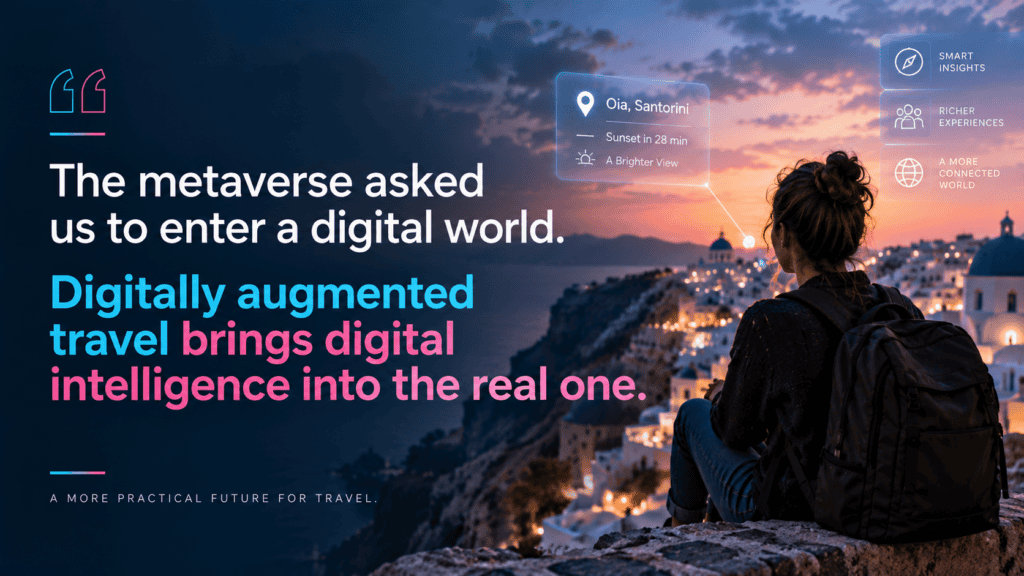
There is an interesting paradox in all this. For much of the past 15 years, travel technology has made journeys easier while simultaneously pulling more of our attention towards the smartphone. We navigate through it, buy tickets through it, translate with it, photograph with it, search through it and increasingly experience parts of a destination through a six-inch screen.
The next generation of technology may begin to reverse some of that. Micro devices, intelligent audio, smart glasses, spatial interfaces and real-time interpretation could allow technology to become less intrusive rather than more. The visitor may receive more information while spending less time looking at a device.
Through my work with Vox, I see this particularly clearly in guiding, interpretation and multilingual communication. The basic requirement has not changed. People want to understand where they are and what they are seeing. What is changing is how intelligently, personally and unobtrusively that understanding can be delivered.
Generative AI takes this another step. Traditional interpretation is generally fixed: someone writes the guidebook, records the audio guide or creates the museum panel, and the visitor receives what has already been prepared.
AI introduces the possibility of conversation. A visitor might ask why a building is important, what was happening elsewhere at the same time, how to explain something to a ten-year-old, or what most visitors miss.
The place has not changed. The visitor has not left it. But the layer of understanding around it can become personalised, responsive and multilingual.
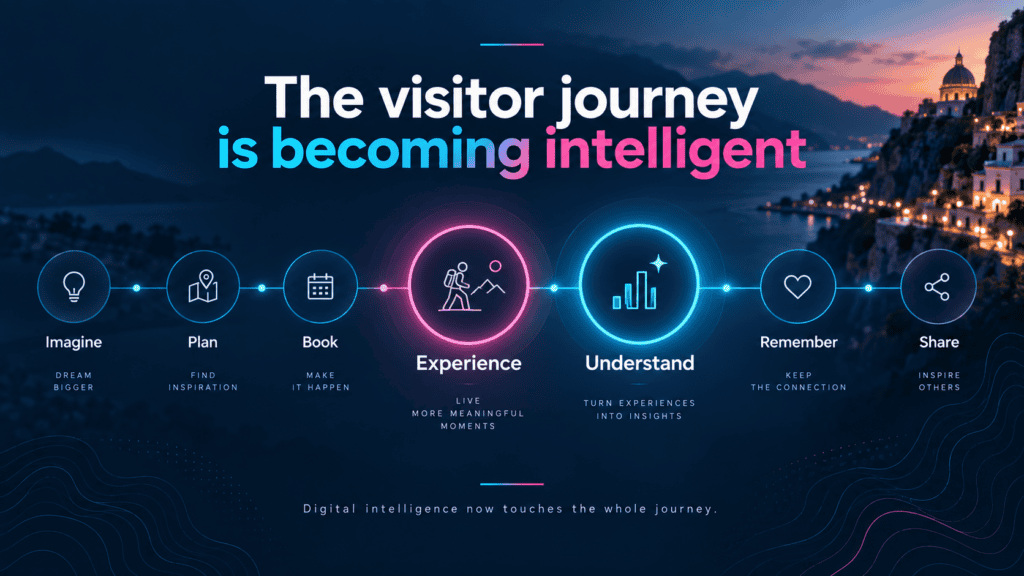
This change does not begin when somebody arrives at the destination. Increasingly, technology touches the entire visitor journey.
AI is already reshaping inspiration and planning. Conversational search allows travellers to describe what they want in ways that conventional search boxes never really permitted. Recommendation systems can become more contextual. Products can be compared and assembled around preferences rather than rigid categories.
And this raises another interesting question for travel businesses. For decades, one of the central marketing challenges has been: how well do we understand our customer?
Increasingly, we may also need to ask: how well can our customer’s technology understand us?
The traveller remains human, but the first point of discovery may increasingly be an AI agent searching, comparing and interpreting products on their behalf. That does not automatically mean the demise of brands, travel agents, resellers or intermediaries. Distribution has rarely evolved quite that neatly.
Consumers will continue to value trust, reassurance, aggregation, inspiration and the confidence that somebody will be there when something goes wrong. But businesses may increasingly need to communicate simultaneously with two audiences: the human traveller and the technology acting on their behalf.
Product information, availability, pricing, terms, relevance and reputation therefore need to be understandable not only to people but increasingly to machines. That has potentially profound implications for brand and distribution.
The brand still needs to mean something to the traveller. But it may also need to be sufficiently clear, trusted and machine-readable to be surfaced by the traveller’s AI.
That is a new form of discoverability.
Mobility may be another important part of this story.
Traditionally, sightseeing economics have favoured groups. A coach carrying 40 people along a predetermined itinerary is considerably easier to make economical than providing 40 individually tailored journeys.
Private touring has always offered something different. A couple, family or individual can determine where they go, when they stop, what interests them and how long they stay. But that flexibility has generally carried a premium and has therefore been associated particularly with luxury and bespoke travel.
One point made particularly well by Alex Bainbridge at TTI was that autonomous mobility could begin to change those economics.
If smaller autonomous vehicles can cost-effectively serve couples, families and eventually individuals, highly personalised itineraries may become scalable in ways that were previously difficult. Add AI planning, contextual interpretation, live traffic and visitor-flow information, multilingual guidance and the ability to alter the itinerary dynamically, and the significance is no longer simply that nobody is driving the vehicle.
A family might leave its hotel with an itinerary created around its own interests, alter it during the day, spend longer somewhere that particularly appeals, skip somewhere that does not, and receive interpretation throughout in its own language.
The more interesting possibility is that a level of personalisation once associated mainly with expensive bespoke travel could become available to a much wider market.
Mobility itself begins to become part of the experience.
That does not mean autonomous vehicles will automatically eliminate tour operators, resellers or intermediaries. The eventual distribution model is much less certain. But they could change the economics of how personalised sightseeing is delivered, which in itself would be a significant shift.
Digital twins illustrate the same convergence from another direction.
The term is already used quite broadly, but at its most established it refers to data-connected representations of physical systems: airports, venues, attractions or cities that help operators understand passenger flows, congestion, capacity, staffing and different scenarios.
Increasingly, however, digital representations also have a consumer role. Visitors can explore hotels, attractions, venues and destinations before travelling. Over time, those two worlds may begin to meet.
A destination that understands what is happening in real time can potentially use that intelligence not simply to improve its own operations, but to improve the visitor’s experience too. Where is it busy? What is accessible? What has changed? What might be more suitable for this particular visitor at this moment? Where should they go next?
Again, the direction is the same. Digital intelligence is being brought into the real journey.
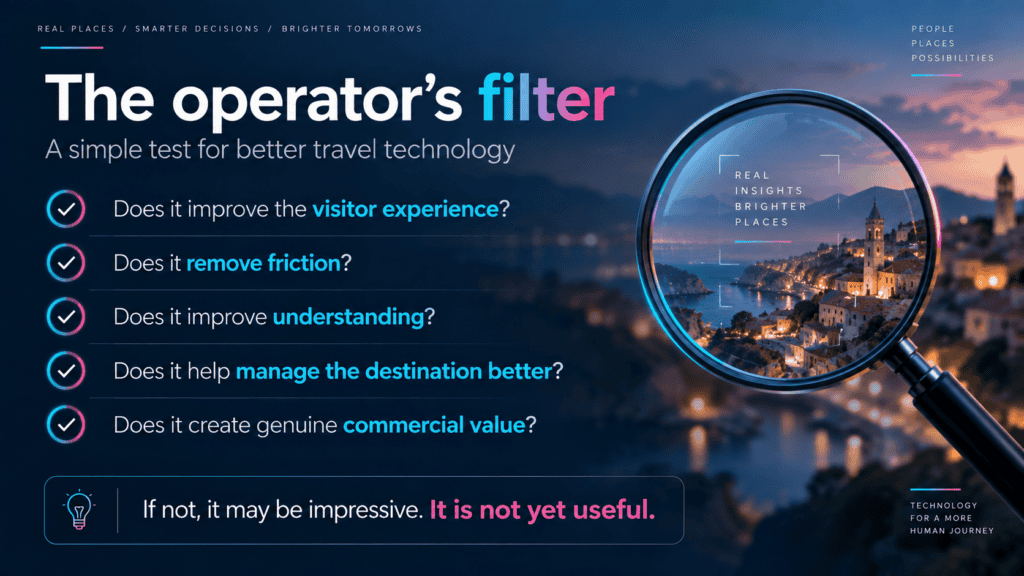
There is, however, a danger in all discussion of emerging technology. Travel has never suffered from a shortage of clever solutions looking for problems to solve, and operators, attractions and destinations already work with finite budgets, limited management bandwidth and considerable operational complexity.
Technology therefore has to earn its place. My own filter is fairly simple: does it improve the visitor experience, remove friction, improve understanding, help manage the destination better, or create genuine commercial value?
If the answer is none of those things, the technology may still be impressive, but it is probably not yet particularly useful.
That, perhaps, is one of the biggest differences between the metaverse moment and where we find ourselves today. The metaverse conversation was dominated by possibility. The next phase feels increasingly governed by utility.
So what happened to the metaverse?
Perhaps it did not disappear at all. The grand vision fragmented, some of the hype faded and some of the terminology changed. Technologies that had once been packaged together began evolving independently, finding more practical applications and responding more closely to what travellers and travel businesses actually wanted.
Travel, almost quietly, moved with them.
That is why I think the idea of digitally augmented travel is useful. It describes a future that does not require us to choose between technology and the physical world, or between digital intelligence and human interaction. Quite the opposite.
The opportunity is to use technology to make the real world easier to navigate, more accessible, more understandable, more personal and ultimately more rewarding.
Travel’s greatest asset has always been reality: its people, places, cultures, stories and unpredictability. The future is not about replacing those things. It is about giving travellers better ways to experience them.
The metaverse asked us to enter a digital world.
Digitally augmented travel brings digital intelligence into the real one.
This article developed from my opening keynote, A Whole New World, delivered at the TTI Autumn Conference in London in September 2026. My thanks to Paul Richer for inviting me to explore the theme, and to fellow speakers Jay Scott-Nichols, Ric Corbett, Alex Bainbridge and Alex Hurd for the wider discussion and ideas shared during the morning.
Particular thanks to Alex Bainbridge for his perspective on autonomous mobility and the potential for smaller, highly personalised sightseeing journeys to become more economically scalable.
Some of the supporting visuals used in this article were created with the assistance of generative AI and then edited and selected to support the themes discussed.