For several years, we have been told that business has changed forever.
Meetings can be held online. Products can be demonstrated through video. Buyers can research suppliers without leaving their desks. Sales funnels can be automated. Artificial intelligence can draft proposals, summarise calls, recommend contacts and follow up at speed.
All of that is true. Much of it is useful. Some of it is genuinely transformative.
But it does not make trade shows, exhibitions or Expos less relevant. In many ways, it makes them more important.
Because the more business life becomes digital, automated and remote, the more valuable it becomes to meet people properly. Not just to exchange information, but to build trust, test ideas, understand context and create momentum.
Digital tools are very good at distributing information. They are not always so good at creating belief.
A good trade show is not simply a place where companies exhibit products. It is a marketplace of confidence.
Buyers attend to see what is real. Suppliers attend to demonstrate capability. Destinations attend to tell their story. Investors attend to read the room. Associations attend to understand what their members are facing. Journalists attend to detect the emerging narrative. Competitors attend to learn from one another, whether they admit it or not.
The value is partly commercial, of course. Leads are generated, partnerships are formed and contracts are progressed. But the deeper value is often less visible. It sits in the conversations between meetings, the introductions that were not planned, the reassurance that comes from seeing a business show up with confidence, and the collective sense that a sector still has energy.
That matters.
Recent CEIR research, reported by PCMA, suggests that B2B exhibitions remain the largest marketing investment for many exhibitors, with face-to-face exhibitions accounting for the biggest share of exhibitor marketing budgets.[1]
UFI, the Global Association of the Exhibition Industry, also reports that in 2024 the global exhibition industry brought together 4.7 million exhibiting companies and 318 million visitors, generating about €150 billion in direct output.[2]
That is not a marginal activity. It is part of the commercial infrastructure of global business.
The travel industry has always understood the power of meeting.
Tourism is built on confidence, relationships and shared experience. A destination can have excellent assets, strong airlift and beautiful marketing, but if buyers do not believe in the product, if operators are nervous about demand, or if travellers are uncertain about safety or value, the market slows.
This becomes especially important after disruption.
When a destination, region or sector has been affected by crisis, recovery does not happen simply because flights resume or hotels reopen. Confidence has to be rebuilt. The story has to be retold. Partners have to be reassured. Distribution has to be reactivated. Buyers need to look people in the eye and hear a credible plan.
That is where travel trade shows still play a vital role.
The current volatility in the Middle East is a reminder of how quickly travel patterns can be affected. Reuters reported on 26 June 2026 that Heathrow had reduced its 2026 passenger and profit forecasts because of disruption linked to the Iran conflict and wider Middle East uncertainty.[3] WTTC has also warned that the conflict is costing the Middle East travel and tourism sector at least US$600 million per day in lost international visitor spending.[4]
At moments like this, the industry needs more than email updates and digital campaigns. It needs forums where airlines, destinations, operators, hotels, attractions, technology providers and government bodies can come together, compare reality, explain responses and rebuild confidence.
This is not about pretending everything is fine. It is about creating the conditions in which the market can begin to move again.
There is a reason that trade show participation carries meaning.
When a company invests in exhibiting, it is making a statement. It is saying that it is active, visible and engaged. When a destination takes space at a major travel market after a difficult period, it is saying that it is open, serious and ready to talk. When senior leaders attend in person, they are signalling that the conversation matters.
That message cannot be replicated entirely online.
A webinar can inform. A video call can maintain contact. A digital campaign can create reach. But none of them quite carries the same weight as being physically present in the market, with a team, a proposition and a willingness to engage.
This is why the timing of major travel events matters. Arabian Travel Market 2026 is now scheduled for 14 to 17 September at Dubai World Trade Centre.[5] WTM Spotlight Riyadh is also scheduled for 8 September 2026 and is being positioned as a platform where Saudi Arabia’s travel and tourism story connects with the world.[6]
Those events are not just diary entries. They are moments of convening. They allow sectors and destinations to move from individual uncertainty to shared conversation.
Trade shows help industries do business. Expos do something broader.
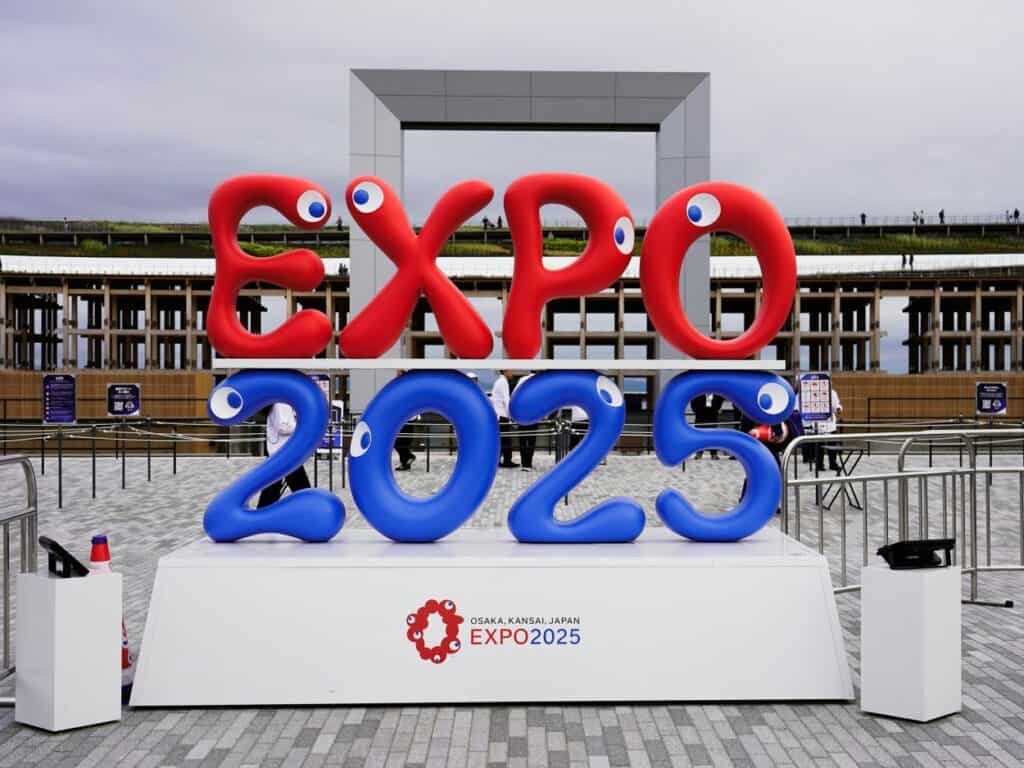
A World Expo is part exhibition, part public diplomacy, part national showcase and part visitor experience. It allows countries to explain what they stand for, what they are building, what they value and how they wish to be understood.
The Bureau International des Expositions describes World Expos as global platforms for public engagement, public diplomacy and nation branding.[7]
That is why Expos matter beyond their gates.
They can support tourism, trade, investment, cultural exchange, urban development and international perception. They can provide a stage on which a country introduces itself again, not through advertising alone, but through design, hospitality, interpretation, programming, technology, food, people and experience.
Expo 2030 Riyadh will take place from 1 October 2030 to 31 March 2031 under the theme “Foresight for Tomorrow”. The official Expo site describes it as a platform for nations, innovators, organisations and people to collaborate, showcase innovation and turn foresight into action.[8] The BIE also frames Expo 2030 Riyadh around innovation, sustainability and collective action.[9]
That is a powerful brief. But the real test of any Expo is not only architectural scale or visitor numbers. It is whether the event creates genuine connection between people, ideas, businesses, cultures and countries.
The most successful Expos are not just spectacular. They are legible. They help visitors understand a country, a theme and a moment in time.
It is tempting to describe the community value of trade shows and Expos as intangible. In one sense, it is. But intangible does not mean unimportant.
Industries need places where they can think together. They need moments when competitors become colleagues, when younger professionals see the wider sector they belong to, when ideas move from private frustration to shared agenda, and when people remember that they are part of something bigger than their own organisation.
Of course, trade shows and Expos are not the only places where this happens. Trade associations, industry forums, chambers of commerce and professional networks all play an essential role in maintaining dialogue, advocacy and community throughout the year.
But major events do something different.
They concentrate attention. They create a shared moment. They bring the wider ecosystem into the same physical space and, for a few days, allow an industry or a nation to see itself, test itself and project itself to the world.
That concentration of people, purpose and energy is hard to replicate online.
It helps businesses find partners. It helps associations understand priorities. It helps organisers identify emerging themes. It helps destinations shape their narrative. It helps technology providers understand operational reality. It helps investors sense confidence or hesitation.
And perhaps most importantly, it creates momentum.
Anyone who has spent serious time in travel, tourism, attractions or events knows that progress often starts with a conversation that was not in the diary. The chance encounter. The quick coffee. The introduction after a panel. The comment from a buyer that changes the way a product is explained. The competitor’s stand that quietly raises everyone’s game.
The value of a good trade show is not only in the meetings you planned. It is in the conversations you could not have scheduled.
None of this means that every event is worth attending, or that every stand delivers value.
Trade shows can be expensive. Teams can be underprepared. Messaging can be weak. Follow-up can be poor. Some businesses still treat exhibiting as a matter of presence rather than purpose, and then wonder why the return is unclear.
The best exhibitors behave differently.
They know why they are there. They brief their teams properly. They make it easy for visitors to understand their proposition. They use the event as part of a longer commercial journey, not as a three-day burst of activity. They follow up quickly. They listen as much as they sell.
The best organisers also understand that their role is no longer simply to rent space. They are curators of commercial energy. They create theatres of content, spaces for dialogue, platforms for innovation, opportunities for networking and reasons for senior people to attend.
That is where the future of events lies.
Not in nostalgia for the old exhibition model, but in smarter, more purposeful convening.
There is a paradox at the heart of the current moment.
The more digital business becomes, the more human presence stands out.
In a world of automated outreach, AI-generated content and remote communication, the act of showing up becomes more meaningful. Meeting someone in person says something about seriousness. Listening carefully says something about respect. Hosting well says something about culture. Building a stand, preparing a team and participating in a wider industry conversation says something about confidence.
Trade shows and Expos are not relics of a pre-digital age. At their best, they are where digital capability, human judgement, commercial intent and collective imagination come together.
For travel and tourism, that matters enormously. This is an industry that sells experience, trust, welcome and memory. It cannot afford to become faceless.
The future will certainly be more digital. It will be more automated. It will be more data-driven. But the businesses, destinations and countries that thrive will still be those that know how to convene people, tell their story clearly and create confidence face to face.
We still need to meet.
Perhaps now more than ever.