As the heat of summer begins to soften and the evenings draw in, attention across much of the travel industry begins to turn towards the next great annual ritual.
Trade show season.
From September through to March, exhibition halls from London and Madrid to Berlin and beyond will once again fill with destinations, operators, attractions, technology companies and suppliers, all competing for attention, conversations and, ultimately, business.
Right now, thousands of exhibitors will be deep in preparation. Stands are being designed. Brands are being tweaked. Graphics approved. Videos produced. Brochures updated. Meeting diaries opened and invitations sent.
There is certainly no shortage of guides and checklists telling us how to prepare for a successful trade show. Most cover much the same ground: stand design, messaging, collateral, pre-show marketing, appointments, lead capture and follow-up. All useful and all necessary.
But I see it slightly differently.
Eventually there comes a moment when the stand builders leave, the screens are switched on, the brochures are lined up, the coffee machine is switched on and the doors open.
For the next two or three days, your exhibition stand is a live customer-facing business.
And that business needs to be run.
One of the interesting things about trade shows is that different parts of the same organisation can arrive with rather different ideas about what they are there to achieve.
Marketing understandably wants the stand to showcase the brand. There may be a new campaign, beautifully produced content, a product launch or the latest corporate video to unveil. The sales team wants meetings and conversations and, let’s admit it, perhaps the opportunity to catch up with a few industry friends they haven’t seen since the last show. Product specialists want to demonstrate the latest innovation, while regional teams want to look after their customers.
Meanwhile, the CEO or founder may be looking at the sizeable investment in floor space, stand construction, travel, accommodation, hospitality and staff time and asking a rather more basic question: what are we actually going to get back from all this?
None of these aspirations is wrong. The problem comes when they haven’t been reconciled. Somewhere in the middle of all this, an actual prospective customer has just walked onto the stand.
That is where the exhibition plan meets reality.
A company may have perfectly sensible corporate objectives for exhibiting, but those objectives need to flow all the way through the operation:
Business objective → Show objective → Stand objective → Team objective → Individual behaviour
If those aren’t connected, it is perfectly possible to have a beautifully designed, extremely busy and apparently successful exhibition that ultimately achieves surprisingly little.
We spend considerable time designing exhibition stands. Perhaps we should spend a little more designing what happens when somebody walks onto one.
Think about the experience from the visitor’s perspective. I slow down as I pass your stand. Does anybody notice? Am I immediately pounced upon and subjected to a sales pitch, or do I stand there for 20 seconds while six members of staff continue their conversation? If someone does approach me, do they first try to understand why I am there?
And if it becomes clear that I really need to speak to somebody else, what happens then? Does the person I’m talking to know who that colleague is? If they’re already occupied, does someone take ownership of me, or am I simply pointed towards the other side of the stand and left to fend for myself?
These may sound like small things, but they aren’t. For that visitor, those few minutes may be their entire experience of your company.
Which raises a question I think is too often overlooked.
A good restaurant doesn’t simply assemble a talented chef, knowledgeable waiting staff, a well-stocked bar and an attractive dining room and assume that a great service will somehow happen. Somebody is watching the room. The maître d’ notices the table that has been waiting too long, the guest who needs attention, the waiter who is overloaded and the moment when the right colleague needs to step in.
An orchestra works on a similar principle. The conductor doesn’t play every instrument. Their job is to understand the whole performance and know when each instrument needs to come in.
An exhibition stand needs that person too.
The Stand Manager.
It sounds obvious, yet it is a role I have often seen missing, or perhaps confused with the person responsible for stand logistics.
What I mean is something rather more important.
The Stand Manager doesn’t need to be the most senior person present, but they should be a seasoned executive who understands the business, its customers and the objectives for the show. They need the judgement to recognise an important opportunity, the confidence to bring the right colleague into a conversation and, crucially, the freedom to see the whole floor rather than spending the day trapped in their own succession of meetings.
They also need clearly delegated authority over the live operation of the stand. The CEO remains the CEO and the Sales Director remains responsible for sales, but while the stand is open somebody needs to be responsible for its flow: who is covering the front, how visitors are received, how appointments and walk-ins are balanced, when specialists are brought into conversations, when people take breaks and where attention is most needed.
In travel terms, there is something of the air traffic controller about it. They are not the CEO of the airport or the captain of every aircraft, but while the operation is live somebody needs the whole picture: what is arriving, what is already occupying capacity, what needs priority and where things need to move next.
That authority needs to be understood by everyone, including the most senior people on the stand. This doesn’t mean the Stand Manager oversees every conversation or directs every movement. Most appointments will happen exactly as planned, and experienced colleagues should get on with doing what they do well.
It is often the exceptions that need the most attention: the important visitor who arrives unexpectedly, the conversation that suddenly needs a different specialist, the appointment that overruns just as another key customer appears, or the apparently casual enquiry that turns out to represent a significant opportunity. These are the moments when somebody needs to see the whole picture and act quickly.
If the Stand Manager needs the CEO to join a conversation, or three colleagues to break up their discussion because the front of the stand has suddenly become busy, there shouldn’t need to be a debate about hierarchy. The authority to manage the stand needs to have been delegated before the show, not negotiated in the middle of it.
And sometimes it is precisely one of those unplanned conversations, recognised and handled well, that can transform the commercial return from the entire exhibition.
Temporary hire hosts can be extremely useful too. Good ones provide a professional welcome, manage appointments and help visitors find the people they are looking for. But somebody who first encountered your company at a briefing that morning cannot reasonably be expected to recognise that the apparently casual visitor asking an unusual question represents an important commercial opportunity.
Someone who really knows the business needs to be watching the room.
There is another lesson from good restaurants worth borrowing. They don’t brief the team once at the beginning of the week and assume everyone remembers the plan. They brief before service. The chef may update the team on the menu, front of house reviews bookings and important guests, the bar has its own information, responsibilities are clarified and the maître d’ makes sure everybody understands what the coming service looks like.
A trade show deserves the same discipline. Ten or fifteen minutes before the doors open, bring the stand team together. Who are we expecting today? Which conversations particularly matter? Who needs to meet whom? Are there demonstrations or announcements everyone should know about? Who is taking breaks, and when?
By Day Two, the briefing becomes more valuable, not less. The team now knows things it didn’t know 24 hours earlier. Which questions keep coming up? Which messages are resonating? Which demonstration is attracting attention? What isn’t working? Who visited yesterday and needs another conversation today? By Day Three, there is the additional challenge of maintaining energy and standards when everyone is beginning to feel the effects of the show.
A good Stand Manager resets the business every morning.
Brief. Open. Observe. Adjust. Debrief. Reset.
Personalised Intentional Nuances (PINs) are the little things that may cost almost nothing but disproportionately shape how a guest feels about an experience. Exhibition stands have their PINs too.
It might be greeting a key client by name rather than waiting for an introduction, or knowing enough about the person approaching to begin a relevant conversation rather than asking a generic question. It might be remembering something they mentioned yesterday, making an introduction that is genuinely useful to them, offering a glass of water without being asked or finding a throat pastille for someone who has spent two days talking over the noise of an exhibition hall.
None of these things is particularly complicated. Nor should they become scripted gestures performed because somebody has put ‘personalisation’ into the stand briefing. They matter because they demonstrate attention, kindness and awareness.
The best Personalised Intentional Nuances aren’t expensive. They simply show that someone was paying attention.
There are other small behaviours that matter for exactly the same reason. Phones away when you’re front of house. Don’t form an impenetrable huddle of colleagues. Don’t eat lunch at the front of the stand. Acknowledge somebody even if everyone is occupied. Make sure the team takes proper breaks before tiredness begins to show, and keep the stand looking as welcoming at four in the afternoon as it did at ten in the morning.
The visitor who arrives late in the day doesn’t know that you’ve already been standing there for seven hours. Their two minutes with you are their entire two minutes with your brand.
Technology has made collecting contact details wonderfully easy, but scanning a badge is not the same as generating a lead. The valuable information is what sits behind the scan: who are they, why did they stop, what are they trying to achieve, what interested them, what problem emerged during the conversation, what did we promise to do next and who owns that action?
A useful way of thinking about lead capture is to work backwards from the follow-up. What will the person picking up this conversation on Thursday morning need to know in order to continue it intelligently?
Returning from a major trade show with hundreds of scans can feel impressive. Returning with fewer contacts but knowing exactly why they matter and what happens next may be considerably more valuable.
This is another area where the Stand Manager can create discipline during the show rather than leaving everything to memory afterwards. Forty-eight hours later, when everyone is back in the office confronting an overflowing inbox, the conversation that seemed unforgettable on Tuesday afternoon can become surprisingly difficult to reconstruct.
Almost every multi-day trade show has its own particular rhythm. The opening is full of energy, the middle days are busy and then, at some point on the final afternoon, things begin to slow. Appointments thin out, the aisles become quieter, everyone is tired and somebody on the neighbouring stand starts packing a box rather earlier than they probably should.
The temptation is understandable. Mentally, the show is over.
Commercially, however, the meter is still running. The floor space hasn’t become cheaper, and neither have the hotels, flights, stand construction or the collective cost of having the team away from their normal jobs.
Perhaps, then, the final afternoon shouldn’t be treated as dead time. It simply needs a different operating mode.
Keep enough people on the stand to give the final visitor exactly the same welcome as the first. Indeed, a quieter aisle can sometimes create the opportunity for a longer and better conversation. But where there is spare capacity, use it deliberately. Release colleagues in rotation to walk the show properly, visit customers and prospects on their stands, look at competitors and see what other exhibitors are doing well. Trade shows are concentrations of market intelligence as well as sales opportunities.
Who did we hope to meet but haven’t? There may still be time for a message: We’re both here for another couple of hours. Do you have ten minutes?
It is also a good moment to review the contacts already collected while the conversations are still fresh. Not to start firing out generic follow-up emails from the stand, but to make sure the useful intelligence has been captured, important opportunities identified and ownership agreed. The quieter period can also provide the chance to take photographs or create short pieces of content that were impossible while the stand was packed.
And start capturing the debrief. What worked? What didn’t? What did customers repeatedly ask us? What surprised us? What would we do differently next time?
Don’t confuse fewer visitors with nothing useful left to do.
Above all, don’t dismantle the customer experience before the organisers close the doors.
Good follow-up begins before everybody leaves. That doesn’t mean exhausted salespeople sitting in hotel rooms sending emails late at night. It means leaving the show with clarity about which opportunities genuinely matter, who owns each one, what was promised and what needs to happen next.
Existing customers may require something quite different from new prospects. Some conversations may need senior involvement; others belong in longer-term nurturing rather than receiving an immediate sales approach. What matters is that these distinctions aren’t reconstructed several days later from a spreadsheet containing names and email addresses.
And perhaps just as importantly, what did the organisation learn? Trade shows are extraordinary concentrations of customers, competitors, partners, ideas and market intelligence. Their value shouldn’t be measured only in badge scans. A short end-of-day huddle can capture immediate actions, while a proper debrief afterwards can look at the bigger picture, including what should change before the next exhibition.
Companies can spend tens or even hundreds of thousands creating an exhibition presence. We debate stand location and square metres, agonise over graphics, commission videos, print collateral, organise hospitality and open meeting diaries weeks in advance.
All of that has a place. But perhaps we spend comparatively little time thinking about how the resulting customer-facing business will actually operate once the doors open.
The best exhibition stands aren’t necessarily the biggest, busiest or most beautiful. They are the ones where purpose, people and execution come together.
So by all means perfect the graphics, polish the presentation and check the coffee machine.
But before the doors open, ask just one more important question.
Who’s running the stand?
This article and the accompanying Exhibition Stand Playbook draw primarily on practical experience of exhibiting, attending, buying, selling, presenting and building relationships at international trade shows over many years.
The thinking has also been informed by contemporary exhibition and event-planning guidance, established hospitality principles, industry practice around stand staffing and visitor engagement, and previous event and roadshow operating frameworks developed through commercial and advisory work.
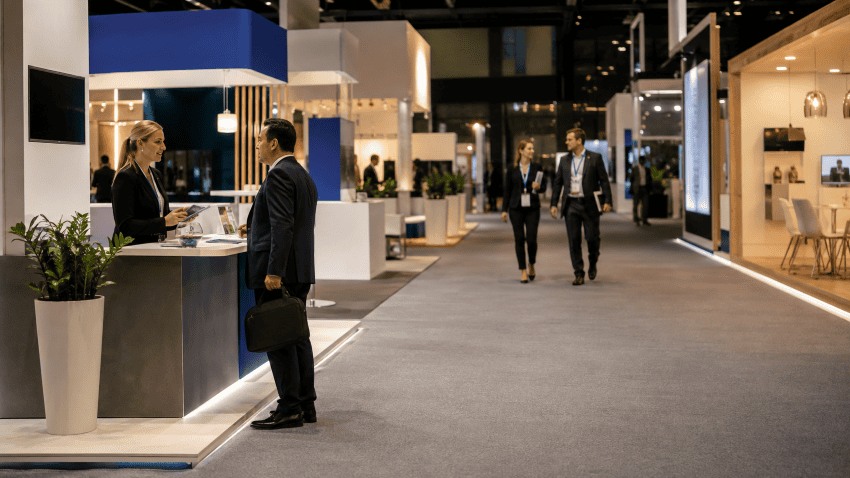
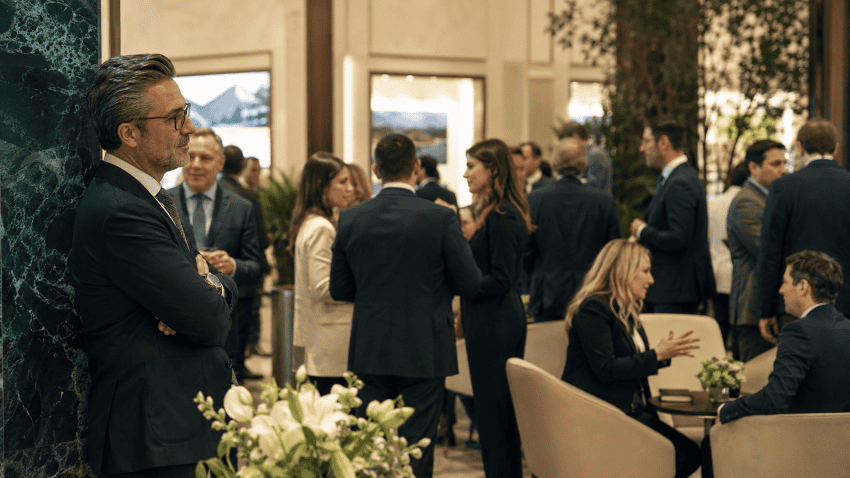
Illustrative exhibition imagery used in the Playbook has been created with AI specifically for this publication and does not depict particular organisations, events or individuals.
The aim is not to prescribe one exhibition formula, but to share practical principles that organisations can adapt to their own objectives, audiences and circumstances.
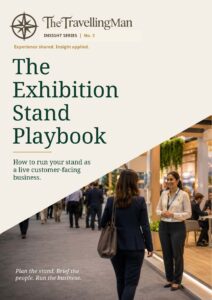
Download The Exhibition Stand Playbook
The companion 16-page Travelling Man Insight Series playbook turns the ideas in this article into practical operating frameworks, daily briefing tools, Stand Manager checklists and ten questions to ask before your next exhibition.